
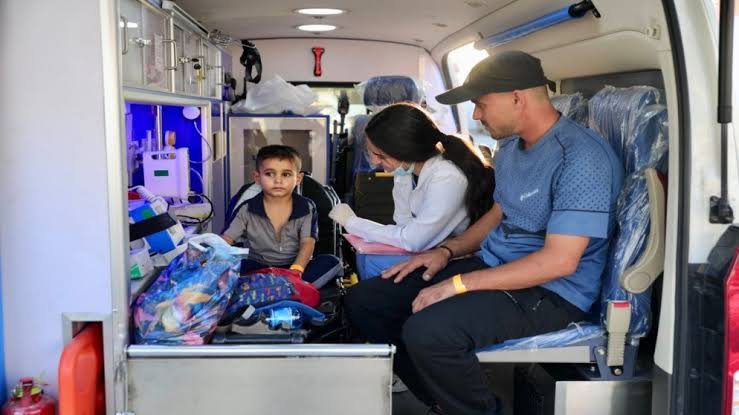

In the Gaza Strip, a patient's or wounded person's journey does not end when a doctor issues a referral for treatment abroad, because the health system in the enclave cannot provide the appropriate care. It does not end when their medical file is complete, nor even when a hospital in another country agrees to receive them. The real journey begins after that: acceptance, coordination, approvals, crossing, inspection, and then travel. Between each link in this chain, a patient waits — while illness does not.
The World Health Organization's latest data show that 12,913 patients and wounded were able to leave Gaza for treatment abroad from October 2023 through August 2026, about 47.9% of them children, and more than 15,000 patients and wounded still need medical evacuation, including more than 3,800 children, making children nearly a quarter of the current waiting list.
This comparison alone reveals the scale of the tragedy: the number waiting for treatment outside Gaza remains larger than the number who managed to reach it, after nearly three years of war. The issue, then, is not merely a shortage of evacuation operations, but an accumulated gap between medical need and the system's capacity to move patients toward treatment.
A Referral Is Not a Plane Ticket
The most dangerous aspect of the medical-treatment-abroad file is that a medical referral may lead a patient to believe the road to treatment has opened, when the reality is different.
There is a medical decision, then a file that needs completion, then a treating institution that must agree to receive the case, then transport coordination, then approvals and crossing procedures. This process involves the Palestinian Ministry of Health, coordinating bodies, the World Health Organization, receiving countries and hospitals, and the Israeli authorities.
A Narrow Path Facing a Long Waiting List
Medical evacuations do not proceed at a pace that allows waiting lists to be cleared quickly. In the period from August 2 to 8, 2026, only 101 patients and 164 companions departed, despite evacuations being carried out three to four times a week.
The significance here lies not in the number itself, but in the gap between the scale of need and the speed of response. If this pace continues, the waiting list will keep renewing itself: new cases are added, existing cases' health needs change, and some patients may not have enough time to wait. This makes medical evacuation part of the treatment itself, not a separate administrative procedure.
Israeli Authorities and Control Over the Final Link
It is impossible to analyze Gaza's medical evacuation crisis without addressing Israeli restrictions on the movement of the sick and wounded.
Even when a patient genuinely needs treatment and a hospital abroad is ready to receive them, the crossing process remains tied to Israeli security approvals and procedures. Human rights reports have documented inspections, delays, and obstruction of patients, companions, and medical convoys along the Rafah crossing route, including cases of detention and delay during crossing procedures.
This turns the crossing from a mere border point into a link in the treatment chain itself. If the required treatment is unavailable in Gaza, preventing a patient from reaching treatment outside it does not simply mean obstructing a person's movement — it means obstructing their access to the healthcare they need.
This grows more severe when a case is critical or when treatment is tied to a medical appointment that cannot be postponed, particularly for cancer patients and those with serious illnesses. Disease does not pause while awaiting approval, and injury does not recede because coordination is delayed.
The Most Important Number Is Not Who Left, but Who Remains
The number of patients and wounded who left for treatment abroad — 12,913 — may seem large, but it becomes far more telling when set beside the more than 15,000 patients and wounded still waiting for evacuation and treatment.
The first number represents those who managed to reach treatment; the second represents those whose right to reach it remains pending.
These patients should not be reduced to mere shifting figures in reports — behind every case is a human being waiting for treatment that may not be available inside the Strip.
The Right to Health Admits No Delay
The right to health does not mean a patient or wounded person receives a referral slip, or that their name is placed on a waiting list — it means they are actually able to reach the appropriate treatment, at the right time, and in a safe and dignified manner.
When the health system inside Gaza is unable to provide specialized treatment, medical evacuation becomes part of fulfilling this right, not an exceptional measure.
Therefore, the responsibility to protect Gaza's patients begins with rebuilding hospitals and medical centers, establishing new hospitals, reviving the health system, and providing treatment inside the Strip — and with opening treatment pathways abroad where needed, while ensuring approvals, crossings, and coordination do not become additional walls before the patient.
Patients and Wounded Who Managed to Travel, While Thousands Still Wait
Behind the numbers lie many legitimate questions: how many patients and wounded must wait before their right to treatment becomes too late to save their life? A referral is not treatment, acceptance is not travel, and travel is not arrival; the right to health is only fulfilled when the patient reaches the treatment they need, at the time they need it.