
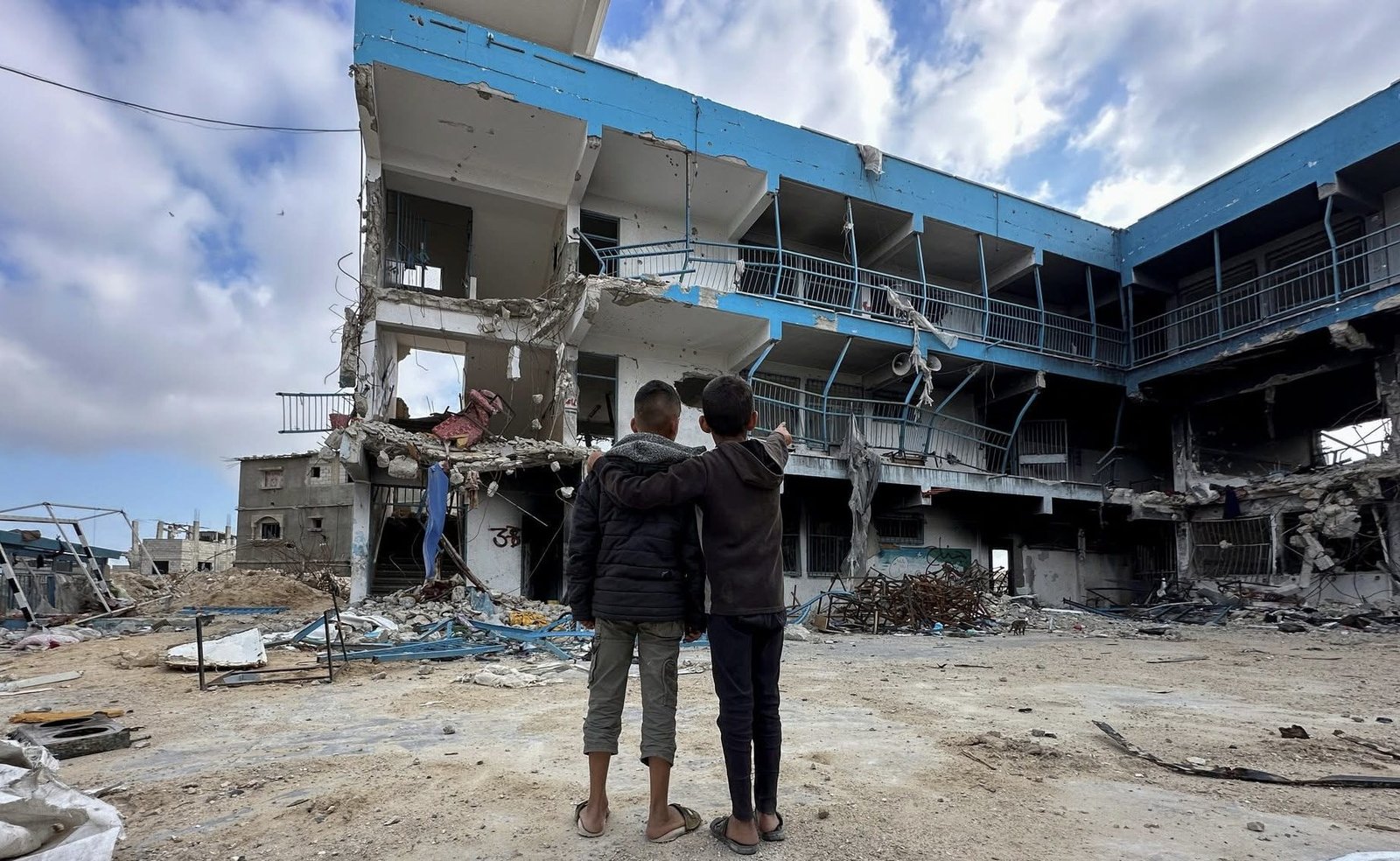

In the Gaza Strip, going to school is no longer an ordinary routine or a self-evident right. It has become a fierce existential struggle: the battle for awareness, which Palestinians are waging with their lives and their children's futures. On this land, fathers and mothers have chosen to defy the Israeli occupation forces, the war of extermination, and the machinery of killing and destruction. They do so with even greater awareness, confronting policies of enforced ignorance and systematic erasure with the sanctity of education, and thwarting plans of displacement and uprooting by remaining steadfast on the rubble. Chasing education amid worn-out tents, under the drone of aircraft and the thunder of shelling, is nothing less than an open declaration of defiance against the guillotine of genocide. It is a deep conviction that every child holding a pencil is building a wall for tomorrow, and that every school bag pulled from under the debris is a document of survival that admits no compromise.
The Crime Continues
To grasp the scale of the educational catastrophe as the 2026/2027 school year begins, one must look at the estimated figures that reflect the depth of the tragedy. More than 85% of school buildings (government-run and UNRWA schools) have been systematically destroyed, while the few schools that survived have turned into overcrowded shelters for the displaced:
• More than 630,000 students are trying to make their way to an education under impossible conditions, roughly evenly split between boys and girls.
• Over 1,200 learning points have been set up as desperate substitutes in open squares and between the alleys of the camps, most of them tents or tarpaulins that offer no protection from heat or cold.
• Approximately 250,000 students are estimated to have registered for online learning through the official links, in an attempt to cling to any hope, despite the lack of the basic requirements for this type of education.
Education as a Lifeline
Some may ask: what drives a displaced family, sleeping on the ground with only the sky for a blanket, to rush to enroll its children in learning points that lack the bare minimum?
The answer is that education is no longer merely a path to intellectual growth. It has become the only and final investment of these families. After years of genocide, families have lost their homes, their sources of income, and their savings, and everything now depends on the education of their sons and daughters. They hope their children will build a professional future that secures suitable work, so that they become the lifeline that restores the family's squandered dignity, fulfills its hopes, and covers its daily expenses, which have become a distant dream.
Deep Wounds That Go Beyond the Absence of Walls
The education crisis in Gaza is not limited to destroyed buildings. It extends to every detail of the educational process, which can be summarized in several dimensions we have long warned about:
First: In-person learning points
These points lack the most basic elements of a safe learning environment. Most are worn-out tents that turn into scorching ovens in summer, scalding the children's bodies, and into flooded freezers in winter, numbing their limbs. There are no desks, no boards, no teaching aids, and no decent sanitation facilities.
Added to this is the terrifying psychological dimension. How can the mind of a child who has lost a desk-mate or a teacher to martyrdom, or who lives under the dreadful buzzing of reconnaissance drones, absorb a mathematical equation? There is also a shortage of specialized teaching staff, which has led many recent graduates to take the initiative. Despite the nobility of their effort, they lack the pedagogical experience needed to support children carrying the trauma of a compounded war.
In this vacuum, a cruel phenomenon has emerged: the commercialization of education. Paid private centers and schools have spread. This blatant exploitation of the crisis weighs heavily on heads of households who are already exhausted, forced to cut into their daily bread and pay what they do not have, hoping to secure that last chance for their children.
Second: The digital mirage
Despite the registration and wide turnout, online learning collides with a bitter reality: constant power outages and weak or nonexistent internet networks. Students also suffer from an acute shortage of smart devices (phones, computers, and tablets), a shortage imposed by force of arms, as the Israeli occupation forces prevent their entry into the Strip. The result is a deepened divide: education becomes the preserve of those who own a device and have power, while tens of thousands are left in digital darkness.
Ambition That Embraces the Sky, and a Reality Shackled by Rubble
Amid this bleak scene, my daughter Rasil stands on the threshold of her first school year, her eyes gleaming with an ambition that transcends the borders of Gaza's besieged sky. She is already planning her future and tells me eagerly that she wants to become a doctor. But as parents, we swallow the lump of fear, for we do not know what fate holds for us in a city where dreams are assassinated every day.
We registered Rasil through the online link approved by the Ministry of Education for enrollment in first grade of primary school, and we waited a long time. But like thousands of families, we never received any message telling us which school or learning point is closest to where we are displaced.