
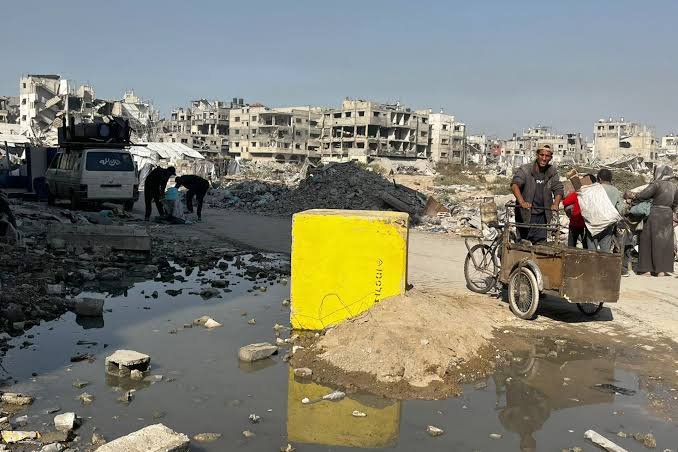

The Tragedy of a Slow Death in the Gaza Strip
In the Gaza Strip, the colors of the spectrum are no longer a reason for hope, but have become military terms that draw lines of blood and death. Since the announcement of the "calm agreement" in October 2025, the Israeli occupation has invented new geographic designations for the Strip, based on fragmenting areas and imposing buffer zones and sieges under color codes; the most prominent and bloodiest of these is the "Yellow Line."
Nostalgia always drives me to visit the Jabalia refugee camp, to check on my birthplace, where I meet residents, relatives, and friends, listen to their stories, and closely observe the details of this life that does not resemble life. There, where the roar of shells never stops and the whistle of bullets never quiets, the harshest chapters unfold of a tragedy of civilians left to face the daily guillotine of death.
Suffocation from Yellow to Orange
The Yellow Line represents the areas of actual control and ongoing incursion by Israeli occupation forces in the Gaza Strip. This line extends like a venomous snake swallowing the geography; starting from the north of Beit Lahia, and the entirety of Beit Hanoun, passing through the east of Jabalia city, the governorates of Gaza and Deir al-Balah, reaching the east of Khan Younis governorate, before curving south to devour two-thirds of the area of Rafah governorate.
Despite claims of existing understandings, the expansion of this line has not stopped. Satellite data from the United Nations Satellite Centre (UNOSAT), reports from the Food and Agriculture Organization (FAO), and human rights organizations confirm that this military expansion has now swallowed more than 65% of the Strip's total area, and that around 95% of agricultural land has been taken completely out of service (including the destruction of greenhouses and orchards along the eastern and northern borders), which entrenches a policy of starvation and completely destroys the food basket.
The occupation forces did not stop there, but introduced yet another line for international institutions: the "Orange Line." This classification includes the areas adjacent to the Yellow Line to which residents have returned - such as Beit Lahia, the Jabalia refugee camp, Jabalia al-Balad, al-Tuffah, al-Shuja'iyya, al-Bureij, al-Maghazi, al-Masdar, Deir al-Balah, Wadi al-Salqa, and the eastern area of Khan Younis. In these orange areas, international humanitarian organizations are barred from operating without prior security coordination with the occupation (which is usually refused). This systematic intransigence obstructs the arrival of vital humanitarian services, and condemns to slow execution a human mass estimated by field statistics at around 400,000 people - about 100,000 of them in northern Gaza - living in conditions of complete food and health insecurity.
Return to the Edge of Death
Faced with this terrifying reality, a fundamental question arises: why do thousands of residents insist on staying or returning to the remains of their homes and the tents pitched on the rubble of the orange lines and along the fringes of the yellow lines?
The answer lies in the nature of the Palestinian human being and his bitter reality; it is a return driven by several compelling factors:
Emotional attachment: deep attachment to one's birthplace and memories, and rejection of the idea of final uprooting.
Social structure: the desire to remain within the extended family fold, even under the rubble.
Economic incapacity: the impossibility of affording the costs of continuous displacement, and the total inability to rent apartments or even tent spaces in the central and al-Mawasi areas, which have become overcrowded and economically exhausted.
Quadcopters and Sleepless Nights
Life near the Yellow Line is literally a gamble with one's soul. The head of a household or a child leaves the tent or the rubble of the house in search of a loaf of bread, food from a soup kitchen, or a sip of water, with no guarantee of return. Random gunfire from stationed vehicles never lets up, and artillery shelling targets everything that moves.
The greater terror, however, lies in the near-daily flights of drones (quadcopters), which have turned into a monster hunting civilians in the streets. According to documentation by specialized institutions, dozens of martyrs and hundreds of wounded have fallen since the so-called truce took effect, as victims of sniping operations and direct shelling in the areas of the yellow and orange lines, where civilians are deliberately targeted while carrying out the simplest details of their daily lives, raising the toll of human attrition daily.
And when night falls, a cycle of psychological and physical terror begins: no security, no calm, no sleep. The sounds of various aircraft pierce the ears, and sudden incursions by vehicles under cover of darkness keep residents' nervous systems in a state of constant pathological alertness - a scene representing the harshest forms of collective psychological torture.
The international community's continued turning a blind eye to this deadly geographic engineering, and its reduction of the suffering of hundreds of thousands of human beings to mere colored dots on the maps of international organizations, amounts to actual complicity in the crime. Life near the Yellow Line is not life - it is an open execution chamber, waiting for someone to break down its walls and stop this ongoing bleeding immediately. For life there carries nothing of its name but the letters themselves.